Dental Implants vs Dentures: Which Option Is Right for You?
Dental Implants vs. Dentures: Which One Is Right for You?
When a tooth is gone, the jawbone underneath it starts to resorb, neighboring teeth begin to drift, and bite forces redistribute in ways that accelerate wear on everything that remains. The replacement you choose determines whether that process stops or continues. Dental implants integrate directly with the bone, preserving its volume and density the way a natural root would.
Dentures rest on the gum tissue and do not stop resorption, though implant-supported versions slow it considerably by anchoring into the bone itself. That single biological difference shapes almost every other comparison: how the restoration feels, how long it lasts, what it costs over a decade, and what your options look like if something changes.
The right answer depends on how much bone you have, whether your gums are healthy, how many teeth are missing, your medical history, and what you want your daily routine to look like long term.
Dr. Holly and Dr. Pannella at Westfield Smiles place implants, fit dentures, and offer every option in between, so the recommendation you get here is based on your mouth, not a preferred product.
Below we walk through how tooth loss works, how a dentist evaluates your case, every replacement option side by side, and the aftercare details most people do not think to ask about until later.
If you would rather talk it through with someone first, contact our Westfield office or call us at (908) 233-9280.
What This Guide Covers
- What tooth loss does to your mouth, jaw, and remaining teeth, and why replacement is a health question and not only a cosmetic one.
- How a dentist evaluates you before recommending anything, including the scans and measurements involved.
- Every replacement option side by side, from a single dental implant to a full arch, including how implants work step by step and how modern dentures are made and fitted.
- Implant-supported dentures and All-on-Four as their own middle category, and who each option genuinely suits based on bone, gums, health, and how many teeth are missing.
- Aftercare, daily routines, and what causes each option to fail over time.
Understanding Tooth Loss: What's Actually Happening When Teeth Are Missing
A missing tooth is a gap in a system, not just a gap in a smile. Teeth hold each other in position, share the work of chewing, and keep the jawbone stimulated. Take one out and the rest of the system starts adjusting, usually in ways you don't notice for a year or two.
Adults lose teeth for a handful of predictable reasons:
- Decay that went too far. A cavity that reaches the nerve and can't be saved with a filling or crown.
- Gum disease. The most common cause of tooth loss in adults. The infection destroys the bone and ligament holding the root, and the tooth loosens. Catching it early is why gum disease treatment matters so much.
- Trauma. Sports, falls, car accidents, biting something that didn't give. A knocked-out or fractured tooth is worth a same-day call to our emergency dentistry team.
- A root canal that failed. Sometimes a treated tooth reinfects or fractures below the gumline.
- Planned extraction. A cracked tooth, a hopeless tooth, or crowding that made removal the better call. Wisdom teeth removal is the most familiar version of this.
Whatever the cause, the consequences run the same direction: chewing shifts to the other side and overloads those teeth, the teeth around the gap start to move, speech can change if the gap is toward the front, and the bone that used to support the root begins to thin.
How a Dentist Evaluates Your Mouth Before Recommending Anything
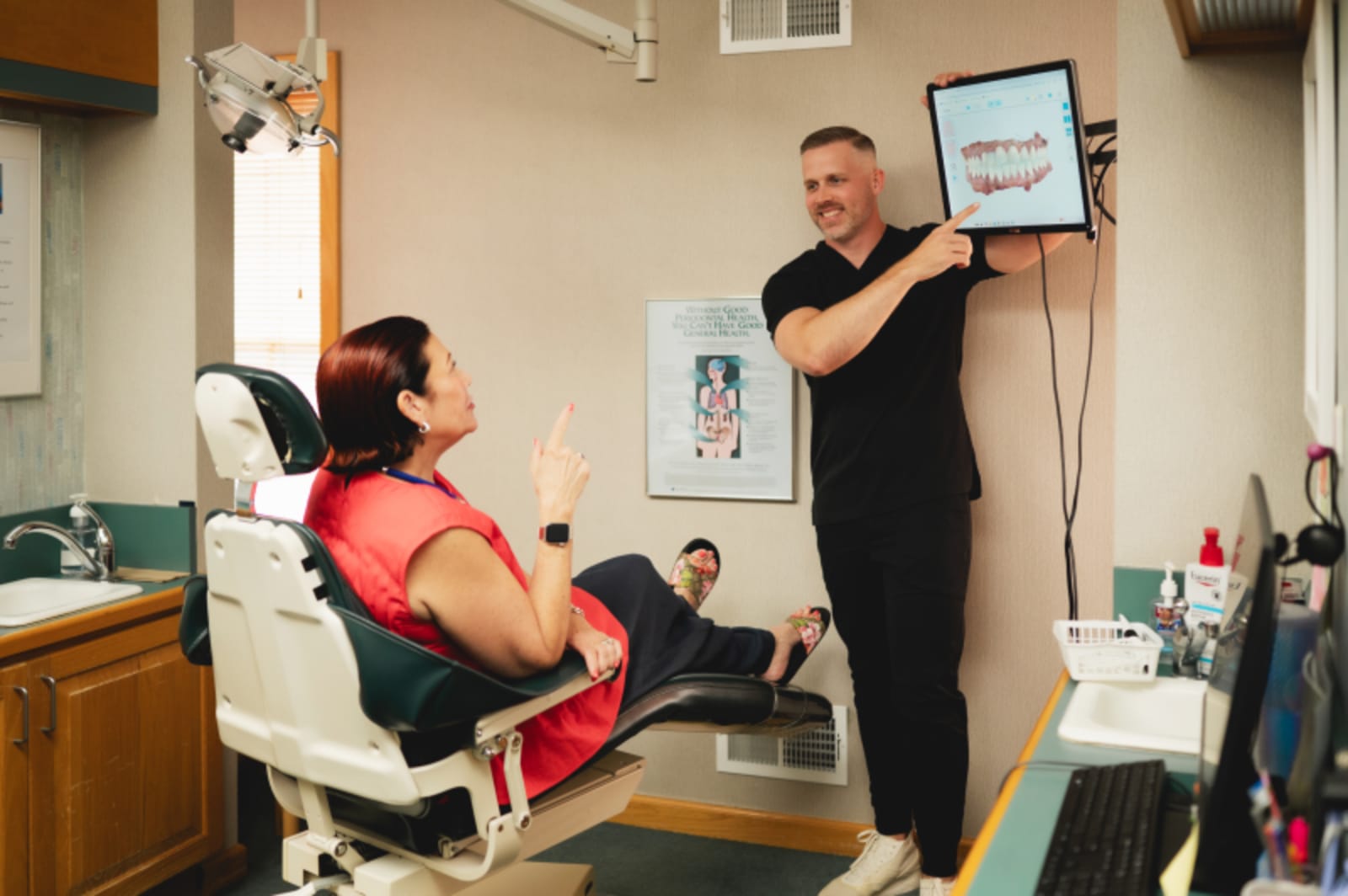
You cannot pick between implants and dentures from an article, and no responsible dentist will quote you a plan over the phone. The recommendation comes out of a workup, and it helps to know what that involves.
The clinical exam
We look at every remaining tooth, check for decay and cracks, test anything questionable, and look at your soft tissues. A tooth you were told to save five years ago may now be part of the conversation. What can be kept changes everything about the plan.
Gum and bone health
We measure the pockets around your teeth and check for bleeding, recession, and mobility. Active gum disease has to be controlled before implants go anywhere, because the same infection that loosens teeth can loosen an implant. If we find it, gum disease treatment comes first.
3D imaging with CBCT
Our CBCT scanner takes a three-dimensional image of your jaw, showing how much bone you have in height and width, how dense it is, and where the nerves and sinuses sit. It's also how we tell whether bone or sinus grafting is needed first.
Digital scanning instead of impression trays
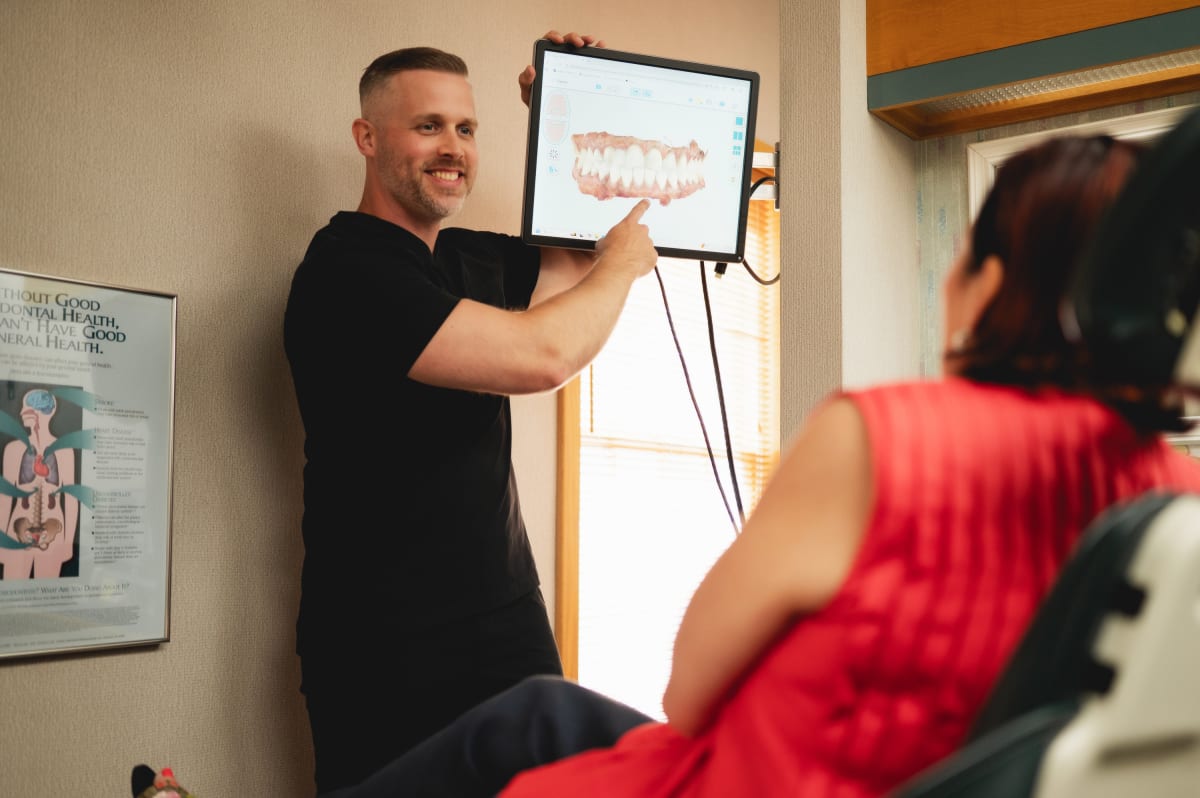
We use iTero and Trios scanners to capture your teeth and gums digitally. A small wand, a few minutes, no tray of putty in your mouth. Those scans become the working model for crowns, dentures, and surgical planning.
Your bite
How your teeth come together determines how much force lands on any restoration. A heavy bite or a grinding habit changes what we design and how we protect it. Skipping this is how restorations fail early.
Medical history and medications
Diabetes control, blood thinners, bone medications, autoimmune conditions, smoking, radiation history: all of it affects healing and surgical planning. Bring your current medication list to your first visit so we have everything we need to plan your care.
The Full Range of Tooth Replacement Options, Side by Side
Most people arrive thinking there are two choices. There are closer to seven, and seeing them together usually clears up half the confusion.
Single dental implant
A single implant replaces one tooth without touching its neighbors: one titanium post in the bone, one crown on top. When only one tooth is missing, it's the most conservative fixed option available.
Implant-supported bridge
When three or four teeth in a row are gone, two or more implants can carry a bridge across the whole span.
Traditional fixed bridge
No surgery. The teeth on either side of the gap are reshaped and crowned, and a replacement tooth is suspended between them. It's faster than an implant and often less expensive up front, though it permanently alters two healthy teeth.
Partial denture
If teeth are missing in more than one area of the same arch, a partial fills those gaps with a removable appliance that clasps onto the teeth you still have.
Full denture
A complete arch of teeth resting on the gum tissue, upper, lower, or both. It comes out for cleaning. Our dentures page covers how we fit and adjust them.
Implant-supported denture
Instead of relying on suction and adhesive, this implant-supported denture snaps onto a small number of implants. You still take it out to clean it, but it stays put while you wear it.
All-on-Four
Four strategically angled implants support a full arch of fixed teeth. Nothing comes out; you clean it in your mouth the way you would natural teeth. We walk through the All-on-Four experience in detail further in this guide.
How Dental Implants Work, Step by Step

An implant is three parts that come together over a few months. Understanding the sequence takes most of the anxiety out of it.
The three components
- The post. A small titanium screw placed into the jawbone where the root used to be.
- The abutment. A connector that attaches to the post once the bone has healed around it.
- The crown. The visible tooth, made to match your others in shape and shade.
Osseointegration, in plain terms
Living bone grows directly against titanium and locks it in place. That fusion is called osseointegration, and it's why an implant feels solid rather than like something sitting in your mouth. It takes a few months, and it isn't a step you can rush.
1. Planning
CBCT scan, digital scan, bite analysis. We map exactly where the implant goes, at what angle and depth, before the day of surgery.
2. Extraction, if needed
If the tooth is still there, it comes out. Sometimes an implant can be placed the same day; sometimes the site needs to heal or be built back up with bone and sinus grafting. The scan tells us which.
3. Placement
The post goes in. This is a shorter appointment than most people expect, done with local anesthetic, with sedation available. You leave with a temporary tooth in most visible areas.
4. Healing
Several months while bone grows around the post. You eat on the other side early on and check in with us along the way.
5. Abutment and final crown
Once the implant is stable, we attach the abutment and take a digital scan for the crown. When it's seated, you brush and floss it like the tooth it replaced.
How Modern Dentures Work: Full, Partial, Immediate, and Flexible
If your picture of dentures comes from a relative's set in a glass on the nightstand, update it. Materials, tooth shapes, and fabrication have all changed, and digital scanning has taken a lot of the guesswork out of the fit.
Full dentures
A complete arch, made to fit the contours of your ridge and held by suction and the shape of the tissue. Uppers usually hold better than lowers, because the palate gives a larger surface for suction. Today's teeth are layered and translucent rather than uniformly white, which is most of the reason modern dentures read as real.
Partial dentures
A framework with replacement teeth that fills gaps while your natural teeth stay put, clasping discreetly to the teeth you still have. Because those teeth carry some of the load, partials often feel more secure than a full denture. If your remaining teeth are shaky, we'll talk through whether dental implants make a steadier foundation.
Immediate dentures
Made in advance and placed the same day your teeth are removed, so you never go without teeth. They protect the healing sites and let you appear in public the next morning. The tradeoff is that gums shrink as they heal, so an immediate denture needs relining, and often replacing with a definitive one, once things settle.
Flexible partials
Made from a pliable resin instead of rigid acrylic with metal clasps. They flex slightly to grip the teeth, weigh less, and hide the metal. Not right for every case, but they suit some patients very well.
How they get made
We record the shape of your ridges with our digital scanning technology, measure how your jaws relate to each other, and choose tooth size and shade with your face in mind. Then you try in a wax version and tell us what you think before anything is finalized. That try-in stage is where a good denture separates from a mediocre one, so take your time with it.
Implant-Supported Dentures and All-on-Four: The Middle Path
Between "removable denture" and "an implant for every tooth" sits a category that suits a lot of people replacing a full arch.
Implant-supported (snap-in) dentures
A small number of implants, often two to four per arch, hold attachments that the denture clicks onto. You take it out to clean it, but while it's in, it doesn't lift, rock, or need adhesive. Lowers are where this changes the most. The denture can also be made slimmer than a conventional one, because it isn't relying on tissue coverage to stay put.
All-on-Four
Four implants, angled to make the most of the bone you have, carrying a full arch of fixed teeth. Nothing comes out. Because the angling often lets us work with existing bone, some patients who were told they'd need extensive grafting turn out to be candidates. In many cases a temporary arch goes on the same day the implants are placed, so you leave with teeth.
Choosing between them
Snap-in dentures cost less and are easier to clean, since you can hold the appliance in your hand. Fixed full-arch feels closest to natural teeth and needs no nightly routine, but it costs more and demands diligent cleaning around the implants. Bone volume, bite force, hygiene habits, and budget all steer the decision, so ask to see both options mapped on your own CBCT scan.
Aftercare and Longevity: Cleaning, Relines, Repairs, and Replacement

Caring for implants
Brush and floss as you would natural teeth, paying attention to the gumline where the crown meets tissue. Special floss or a water flosser helps around bridges and full arches. Keep your professional cleanings, because implants can develop peri-implantitis, an inflammation of the gum and bone around the implant that behaves much like gum disease and is the leading cause of late implant failure. It's largely preventable with hygiene, which is why our dental implant patients stay on a regular recall schedule.
Caring for dentures
Clean them daily with a denture brush and cleaner rather than regular toothpaste, which is abrasive. Rinse after meals, soak overnight, and brush your gums and tongue too. Handle them over a folded towel or a basin of water; most fractures happen on bathroom sinks.
Relines and repairs
Because the ridge underneath keeps changing shape, dentures typically need relining every couple of years to restore fit. Cracks and broken clasps can often be repaired. Don't file, glue, or adjust a denture at home; it wrecks the fit and can damage the tissue.
Realistic lifespans
The implant post itself is designed to last decades and frequently does. The crown or bridge on top is the wear part and may need replacing at some point, much like any crown. Full dentures generally need replacing every five to ten years as fit and materials wear, sooner if you had teeth removed recently. Partials often go a similar distance, depending on what happens with the teeth they clasp to.
What causes each to fail late
Implants that have already fused rarely fail suddenly. They fail slowly, from peri-implantitis creeping around the post, or from years of bite force landing on a crown or arch that was never adjusted for it. Dentures fail as the ridge underneath resorbs and the fit goes unaddressed, from being worn past a needed reline or replacement, and from a drop onto a hard sink. Behind both sit the same risk factors covered under candidacy, now acting over years instead of months. If something feels loose, sore, or different, don't wait for your next scheduled visit — come in so we can catch it early.
Let's Figure Out Which Route Fits You
Both options restore your smile. The difference is in the timeline, the cost curve, the daily routine, and what happens to your jaw over the next twenty years. The remaining piece is a scan of your own mouth and a conversation about what you want your life to look like.
Westfield Smiles is at 440 East Broad St in Westfield, and we're open Saturday mornings until 1:00 if weekdays are hard.
Call (908) 233-9280 and we'll get you in with Dr. Holly or Dr. Sia to sort it out together.
contact us
Call 908.233.9280 or request an appointment online to set up your first visit.